
Motivation in photography is often misunderstood.
It’s easy to assume that inspiration should come naturally, especially if you live somewhere beautiful or have access to interesting landscapes. But motivation doesn’t work that way. It fluctuates. It disappears. Sometimes it returns quickly, other times it lingers just out of reach.
For me, the hardest part about motivation in photography has never been finding time or even finding locations.
It’s been the frustration of not being able to create the images I want to create, something that often comes down to understanding what makes a photograph feel strong.
That gap between vision and result can be discouraging. You go out with ideas, with curiosity, with the hope of coming home with something meaningful. And sometimes you do. But other times, you leave feeling like the photographs didn’t quite match what you saw or felt.
Over time, I’ve come to realize that this experience isn’t unusual. In fact, it seems to be a natural part of creative growth.
Motivation in landscape photography isn’t constant. It moves in cycles, shaped by curiosity, environment, life circumstances, and how we relate to our own work.
Here are a few things I’ve learned about motivation through the years:
Motivation often fades when curiosity fades
One of the most common reasons I feel less motivated is when the places I photograph start feeling too familiar.
Spending a lot of time photographing in the same areas has clear advantages. You learn the terrain, understand the light, and know where compositions might work. But familiarity can also reduce curiosity.
When a place feels predictable, it’s easy to stop looking as carefully.
You might still go out. You might still take photographs. But the sense of discovery that once drove you can become quieter.
This doesn’t mean the location has less to offer. It simply means your relationship to it has changed.
I’ve found that motivation often returns when curiosity returns.
Sometimes that happens through travel and experiencing a new landscape. Other times it comes from smaller shifts; choosing a different focal length, photographing with fewer expectations, or simply allowing yourself to explore without the pressure of coming home with strong images.
In fact, some of the most valuable time I spend for my photography happens without a camera at all.
Going for a hike, a run, or a ski trip helps reset my perspective. It grounds me and reminds me why I was drawn to landscape photography in the first place. Long before I cared about portfolios or publishing images, I simply enjoyed being outside.
That connection to nature is still the foundation.
And remembering that often does more for motivation than any technique or destination.
Losing excitement about your own work is normal
Another challenge with motivation is more internal.
Periods where you simply don’t feel inspired by your own photographs.
Not because of comparison. Not because others are doing better. But because your images don’t quite match what you hoped they would be.
You might come home from a trip knowing the experience was meaningful, yet feel disconnected from the results. The photographs are fine, but they don’t quite reflect what you felt while standing there. Often this comes down to how we interpret and arrange elements within the frame, something I explore further in my guide to composition in landscape photography.
That gap between vision and outcome can quietly erode motivation.
It’s easy to interpret it as stagnation or even regression. But over time, I’ve come to see it differently.
Often, this frustration is a sign of growth.
Your taste evolves faster than your ability to execute it, both in the field and later during post-processing. You begin noticing details and possibilities you didn’t pay attention to before. You recognize what could have been stronger. You see opportunities that felt invisible at the time.
That awareness can feel discouraging, but it also reflects a deeper level of engagement with your work.
I often remind myself that a productive year doesn’t mean producing a large number of strong images.
If I create ten to fifteen photographs I’m genuinely proud of in a year, it has been a good year.
That perspective removes pressure and allows motivation to exist without constant output expectations.
Life doesn’t always allow ideal photography routines
Motivation in photography is also shaped by life outside photography.
For me, this often shows up in the balance between work and personal creative time.
I genuinely enjoy running photo tours and teaching in the field. Spending time with other photographers, exploring landscapes together, and helping people grow creatively is something I find deeply rewarding. But guiding also means responsibility. You’re thinking about group dynamics, safety, logistics, and making sure everyone has a meaningful experience.
Because of that, it’s harder to fully immerse yourself in your own creative process.
There’s a different kind of focus that comes from being alone in a landscape. Moving slowly. Waiting without pressure. Getting lost in a place without needing to explain decisions or consider anything beyond your own curiosity.
During busy tour periods, that kind of personal creative space can be difficult to find.
Time at home adds another dimension.
Being away frequently for tours makes the time spent with family feel even more valuable. And when you return home, deciding to leave again for additional personal trips isn’t always easy, even if the motivation to photograph is there.
I’ve realised that photography has to fit within everything else that matters.
Some periods allow for long, uninterrupted time in the field. Others don’t. And rather than seeing that as a problem, I try to accept it as part of the rhythm.
The motivation is still there. But sometimes it expresses itself differently.
And that’s OK.
Motivation often returns when the agenda disappears
One pattern I’ve noticed over the years is that motivation rarely returns when I try to force it. It comes back quietly, often when photography is no longer the goal.
Some of the moments that reconnect me most with photography happen when I’m outside without a camera. A hike, a run, or a ski trip in the mountains where the purpose is simply to be there.
Something important happens during those moments.
My mind goes quiet.
There are no worries. No stress. No thoughts about images, conditions, or whether something is worth photographing. Just being present in the landscape, right here and right now.
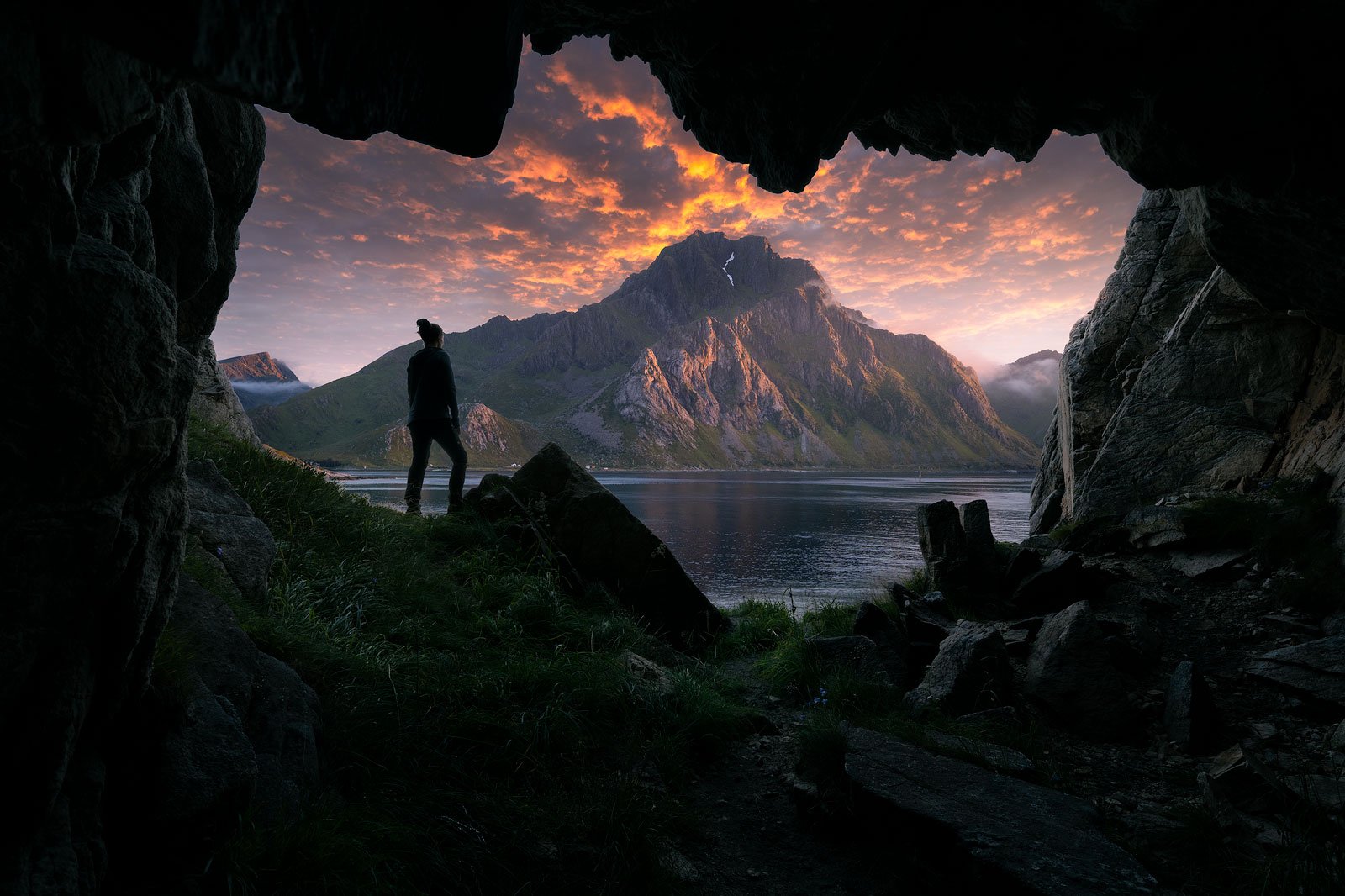
That quiet makes space to observe differently. Not as a photographer searching for compositions, but as someone connecting with the place itself. Feeling the wind, noticing the light, moving through the terrain without any expectation.
That connection is where motivation often returns.
Not because I forced it, but because I remembered why I cared in the first place.
Those moments without the camera aren’t about photography. They’re about connection.
And more often than not, they’re what make me want to come back later, with a camera, and explore again.
Conclusion
Motivation in landscape photography isn’t something I expect to feel all the time.
It comes and goes. Sometimes quickly, sometimes slowly. There are periods where curiosity feels effortless, and others where it takes more patience to rediscover.
Over time, I’ve stopped seeing that as a problem to solve.
Instead, I’ve come to see motivation as something that follows connection.
Connection to places. To experiences. To quiet moments outside where the camera isn’t even part of the equation.
The photographs are meaningful because of that connection, not the other way around.
And when motivation fades, returning to that foundation has proven far more helpful than trying to force it back, a mindset that also influences how I approach photographing in less predictable conditions.
Sometimes the most important step for your photography isn’t picking up the camera.
It’s stepping outside without it.
If you’ve been struggling with motivation, it might be worth asking yourself: when was the last time you spent time in nature without the intention of photographing it?

I’m feeling demotivated. I want to blame outside forces but my own process factors in.
External forces like AI influences in our art cause me to lose appreciation for the pure pleasure of making a picture.
But internal forces like not appreciating my own photos for myself. I got into the habit of chasing likes. Telling myself I didn’t care but checking on the counts. I’ve taken a break from social media, for my sanity and my hope of coming back to photography.
Hi Scott,
It is very interesting that you bring up AI and its influence in photography. Do you find that it affects your work? I’ll admit that some aspects of it bothered me for a while too, but at the end of the day I enjoy the process of being outdoors with the camera, and AI will never take that away – plus I photograph for myself, and don’t feel like I need to prove anything to anyone else.
I think you’re doing something smart by taking a break from social media. Chasing likes certainly affects the motivation (and creativity too I’d say). Hopefully you find it refreshing 🙂
Interesting subject. I have found out that instead of thinking why and how the drive for photography is lost I try to focus on other outdoors activities. I also allow me to nothing at all. Sooner or later the drive will be there as usual 🙂 I guess the keyword here will be patience (with yourself).
Thank you for sharing your insights and experiences.
Brgds,
Dennis
Hi Dennis,
It sounds like we have similar views on this. For me too, it’s not about chasing the motivation but letting it come back at its own pace. And for me, like you say, just being outdoors is the most important!